What a labyrinth is, how the classical one is built, and where it comes from.
What is a labyrinth?
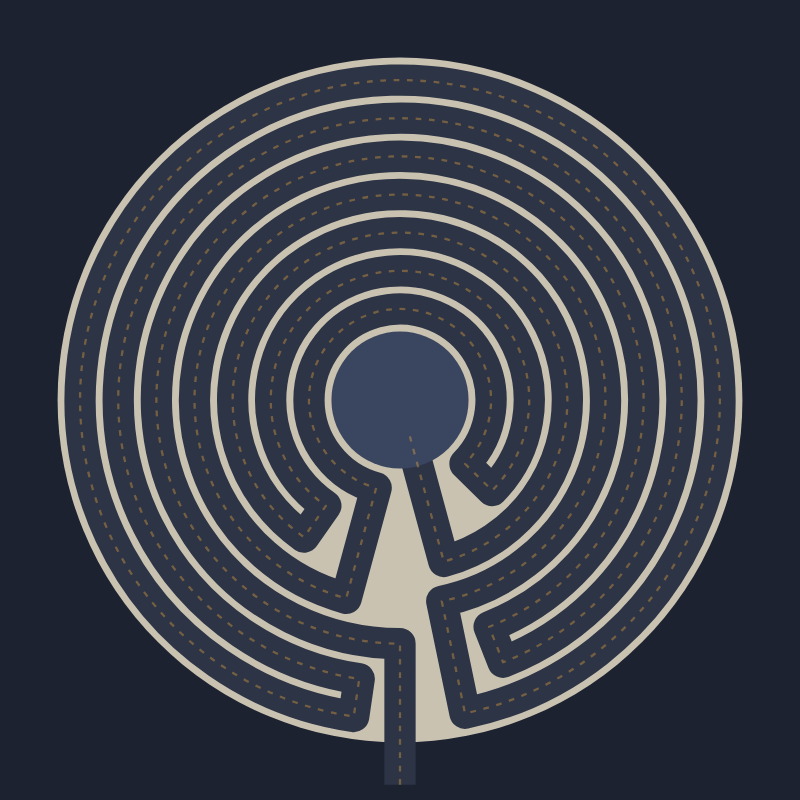
A labyrinth is a single winding path that leads, without any choice, from the entrance to the center.
That is what sets it apart from a maze. A maze is a puzzle, with branches, dead ends and the chance of getting lost (see Maze Maker). A labyrinth has one way in, and if you keep walking you will reach the middle, after passing close to it and being led away again many times. The two words are often used for each other, and the most famous labyrinth of all, the one Daedalus built for the Minotaur, is described in the myth as a place nobody could find their way out of. But the figure drawn on the coins of Knossos and carved on rocks all over Europe is a labyrinth in the strict sense: one path, no choices.
A labyrinth is made of a few parts:
- Circuits
- The rings the path runs around. The Cretan labyrinth has seven, Chartres has eleven.
- Turns
- Where the path doubles back into another circuit. In the classical type they all sit next to one axis.
- Axis
- The line through the entrance and the center, where the turns line up.
- Center
- The goal, often called the heart or the rose.
The path sequence
Number the circuits from the outside in, and write down the order in which the path visits them: that list, the path sequence, describes a labyrinth completely. The Cretan labyrinth is 3-2-1-4-7-6-5, then the center. You enter on the third ring, work your way out to the edge, cross to the fourth, jump to the seventh right next to the center, and then work your way back out to the fifth before stepping in. Labyrinth Maker draws any sequence that works on a single axis, and tells you when the walls would have to cross.
Where labyrinths come from
The classical labyrinth is one of the oldest designs people still draw, and it turns up across the ancient world.
- About 1200 BCEA clay tablet from the Mycenaean palace at Pylos, in Greece, carries a classical labyrinth scratched on its back, the oldest example that can be dated with confidence. Rock carvings in Galicia and Italy may be older, but they are hard to date.
- Classical GreeceCoins from Knossos, on Crete, show the labyrinth of the myth of Theseus and the Minotaur, sometimes round and sometimes square.
- Roman EmpireLabyrinths become a favorite design for floor mosaics, often with the Minotaur at the center, and are divided into quarters.
- About 1200 CEThe eleven-circuit labyrinth is laid into the floor of Chartres cathedral, the best known of the medieval church labyrinths, whose path winds through four quarters.
- Middle Ages onwardTurf labyrinths are cut in English village greens and stone labyrinths laid on Scandinavian shores, many of them called Troy Towns. The Tohono O'odham of the Sonoran Desert have their own version of the classical design, the Man in the Maze.
- Late 20th centuryLabyrinths return as a tool for walking meditation and prayer, in churches, hospitals and parks.
Walking a labyrinth
There is no right way to walk one. Many people walk slowly, letting the path set the pace, and use the three stages of the walk (going in, pausing at the center, coming back out) to let go, to receive, and to return. Because there are no decisions to make, the mind is free to settle. Tracing a labyrinth on paper or on screen with a finger is an old practice too.
About this drawing
Labyrinth Maker draws round, one-axis labyrinths, like the Cretan and the Troy Town types: every circuit goes almost all the way around, and all the turns sit next to the axis, alternately on its right and on its left. The Chartres labyrinth is built differently, with turns on four axes, so the page draws its circuit order (5-4-3-2-1-6-11-10-9-8-7) as a one-axis labyrinth rather than the cathedral's own pattern.