What a mandala is, and where mandalas come from.
What is a mandala?
A mandala is a pattern built outward from a single center point, usually inside a circle, so that every ring and repeated shape points back to the middle.
The word is Sanskrit, maṇḍala, and it most simply means “circle.” In Hindu and Buddhist practice a mandala is more than decoration: it is a diagram of the cosmos, or of a sacred dwelling, that a practitioner studies, visualizes, or walks through in the mind during meditation and ritual. Outside those traditions the word has stretched to cover almost any radially symmetric design, and psychologists use it for the circular images people tend to draw when they are trying to find balance.
Most mandalas, however different they look, are assembled from the same few parts:
- Center
- A point, dot, or seed shape (the bindu) that everything else is measured from.
- Rings
- Concentric bands, each carrying its own motif: petals, flames, beads, triangles.
- Symmetry
- Usually 4, 6, 8, 12, or 16 identical wedges, because those divide a circle cleanly.
- Frame
- A circle, sometimes with a square and four gates inside it, facing the cardinal directions.
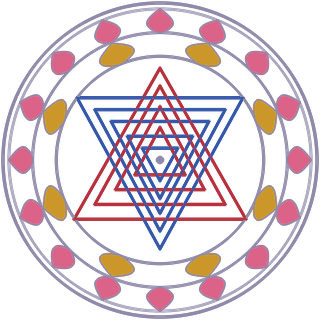 Sri Yantra
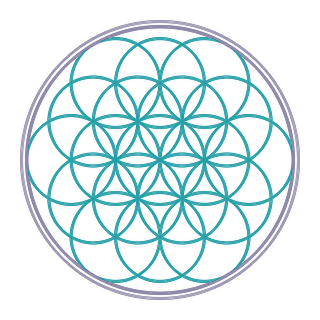 Flower of Life
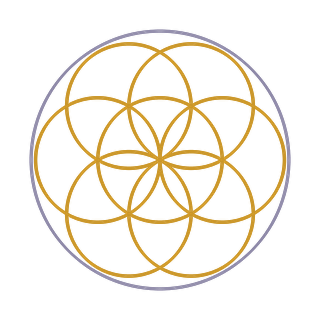 Seed of Life
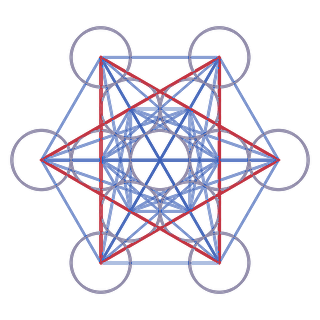 Metatron’s Cube
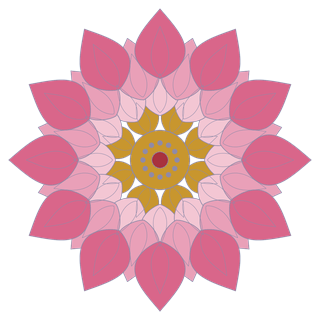 Lotus mandala
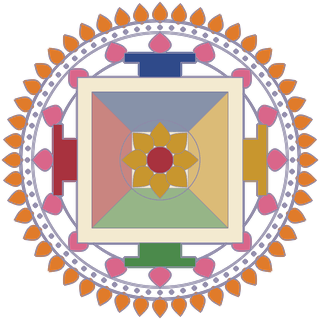 Palace mandala
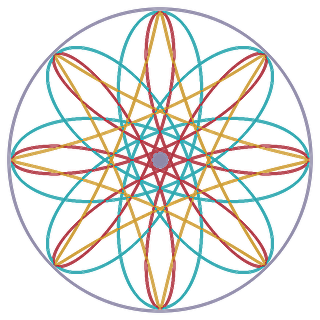 Rosette
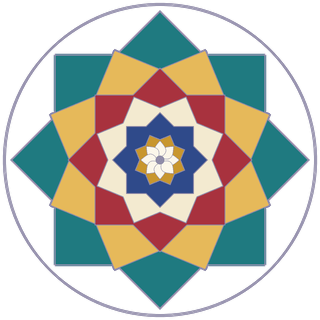 Eight-point star
Where mandalas come from
The idea is older than any single religion, and it grew up in several places at once, but the mandala as we usually mean it took shape in ancient India.
The word already appears in the Rigveda, one of the oldest Sanskrit texts, whose ten books are each called a maṇḍala. From there the circle-and-center form moved into Hindu temple planning and into the yantra, a mystical diagram such as the Sri Yantra. Early Buddhist monuments used the same logic: a stupa is a domed mound laid out around a central axis, and worshippers walk around it clockwise.
The detailed, painted mandala arrived with Vajrayana (tantric) Buddhism, which took shape in India around the seventh and eighth centuries CE. It then traveled along trade routes in several directions.
- Over 3,000 years agoRigveda organized into ten books called mandalas; circular and centered forms appear in early Vedic ritual.
- 3rd c. BCE onwardBuddhist stupas, such as the Great Stupa at Sanchi, are built as walkable, centered monuments with gateways at the four directions.
- 7th–8th c.Vajrayana Buddhism develops elaborate palace mandalas used for initiation and meditation.
- 8th c. onwardMandala practice reaches Tibet, where monks make sand mandalas grain by grain and then sweep them away.
- Early 9th c.The monk Kūkai brings mandala painting from China to Japan, where the Diamond and Womb mandalas become central to Shingon Buddhism. Around the same time, Borobudur in Java is built on a stepped plan often read as a giant mandala.
- Early 1900sCarl Jung adopts the word for the circular drawings he and his patients produced, and treats the mandala as a symbol of the whole self.
- Late 1900sSacred-geometry patterns such as the Flower of Life and Metatron’s Cube are named and popularized in modern spiritual writing, though the overlapping-circle designs themselves are far older.
Circular, centered designs also grew up independently elsewhere: Navajo sand paintings, Celtic knotwork, the star patterns of Islamic tilework, and the rose windows of Gothic cathedrals all use the same radial logic, even though only some of them are called mandalas by the people who made them. That recurrence is part of the appeal. A circle with a center is one of the most natural ways for people to arrange a picture of the world.